The world’s largest congress of parasitologists is held every four years. This year, it brought together nearly 1,500 scientists from 92 countries at the Montreal Convention Centre in Canada on 16–21 August (https://icopa2026.org).

Montreal Convention Centre
Dr. Virmantas Stunžėnas, Dr. Romualda Petkevičiūtė, and Dr. Gražina Stanevičiūtė, helminthologists from P. B. Šivickis Laboratory of Parasitology, delivered three presentations on the latest results of their research, obtained through the RCL-funded project “Biological Diversity of Trematodes in Freshwater Molluscs as an Ecological Indicator of Ecosystem Health” (RCL contract No. S-MIP-25-46)
The gravel snail (Lithoglyphus naticoides), an invasive gastropod is known as an intermediate host for a large group of trematode species whose life cycles have not so far been adequately investigated and whose definitive hosts can only be predicted. In his presentation “Trematodes in Lithoglyphus naticoides (Gastropoda): updating historical data on species identity”, V. Stunžėnas presented the results of molecular and phylogenetic studies on the life cycles of larvae of seven trematode species found in L. naticoides.
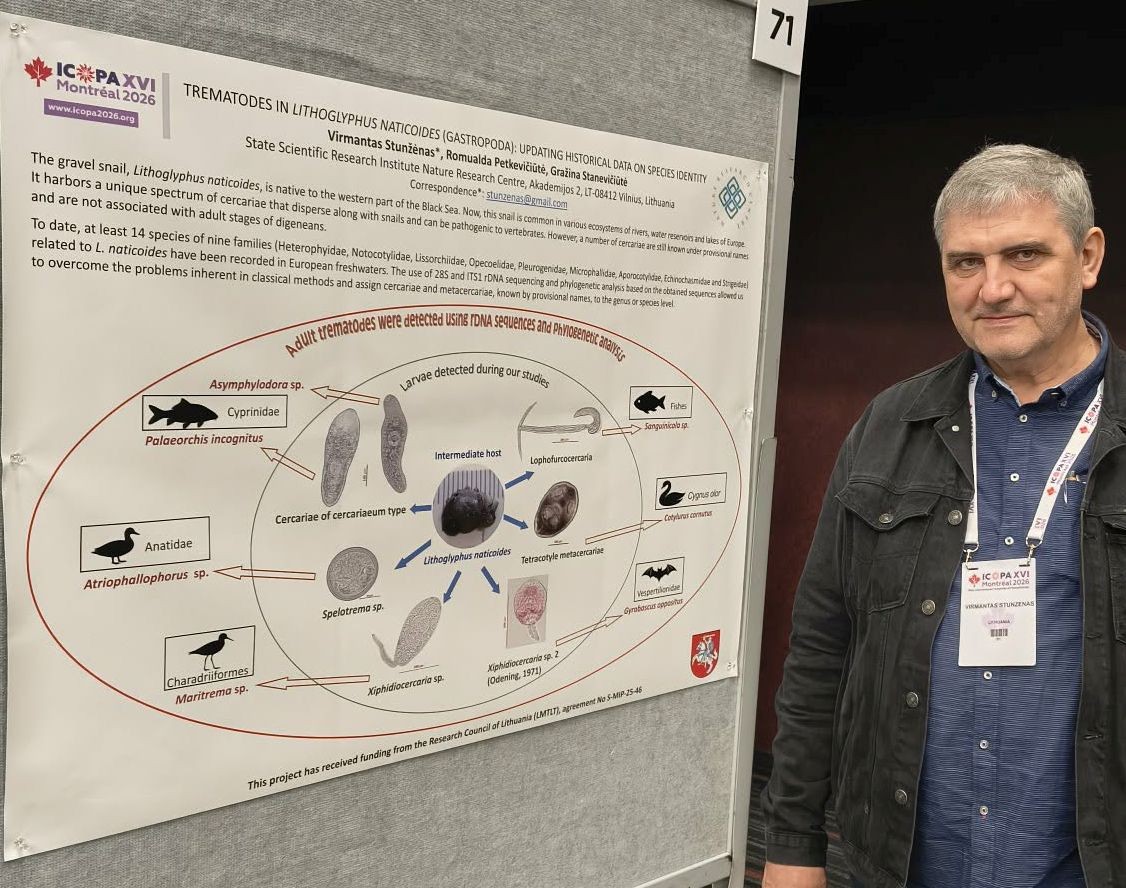
Dr. Virmantas Stunžėnas
The helminthological investigations of gastropods revealed a previously unknown diversity of trematode species. In Romualda Petkevičiūtė’s presentation “Atriophallophorus Deblock & Rose, 1964 (Trematoda, Microphallidae) in gastropod snails from Lithuanian waters”, molecular and phylogenetic analyses based on 28S and ITS2 sequences and karyological analysis of trematodes revealed that at least two unknown trematode species from the genus Atriophallophorus parasitize gastropods in Lithuania.
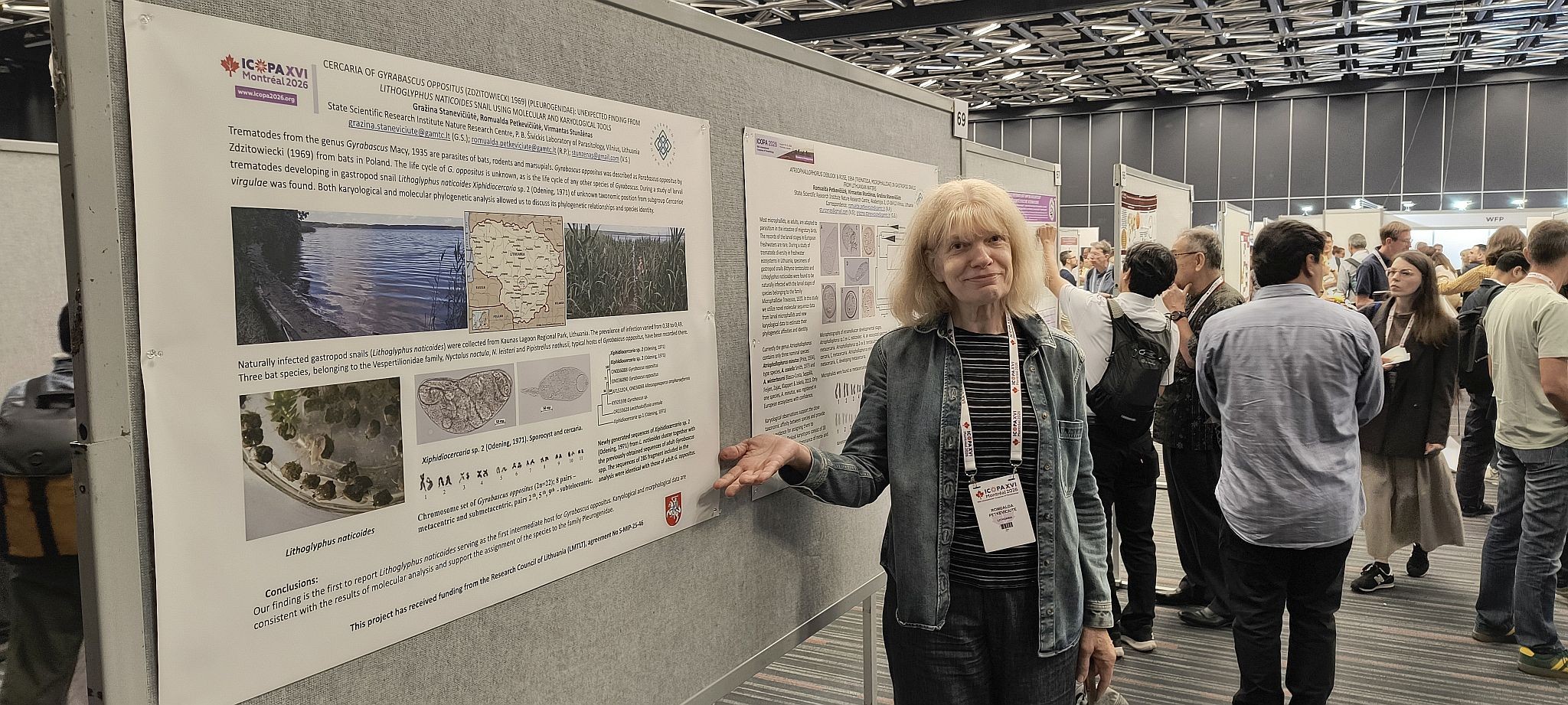
Dr. Romualda Petkevičiūtė
The larval stages of Gyrabascus oppositus, a typical bat parasite, were detected in the gravel snail for the first time. These results, supported by molecular and phylogenetic studies as well as karyological analysis of snails, were presented by Gražina Stanevičiūtė in “Cercaria of Gyrabascus oppositus (Zdzitowiecki 1969) (Pleurogenidae): an unexpected finding from the Lithoglyphus naticoides snail using molecular and karyological tools”.