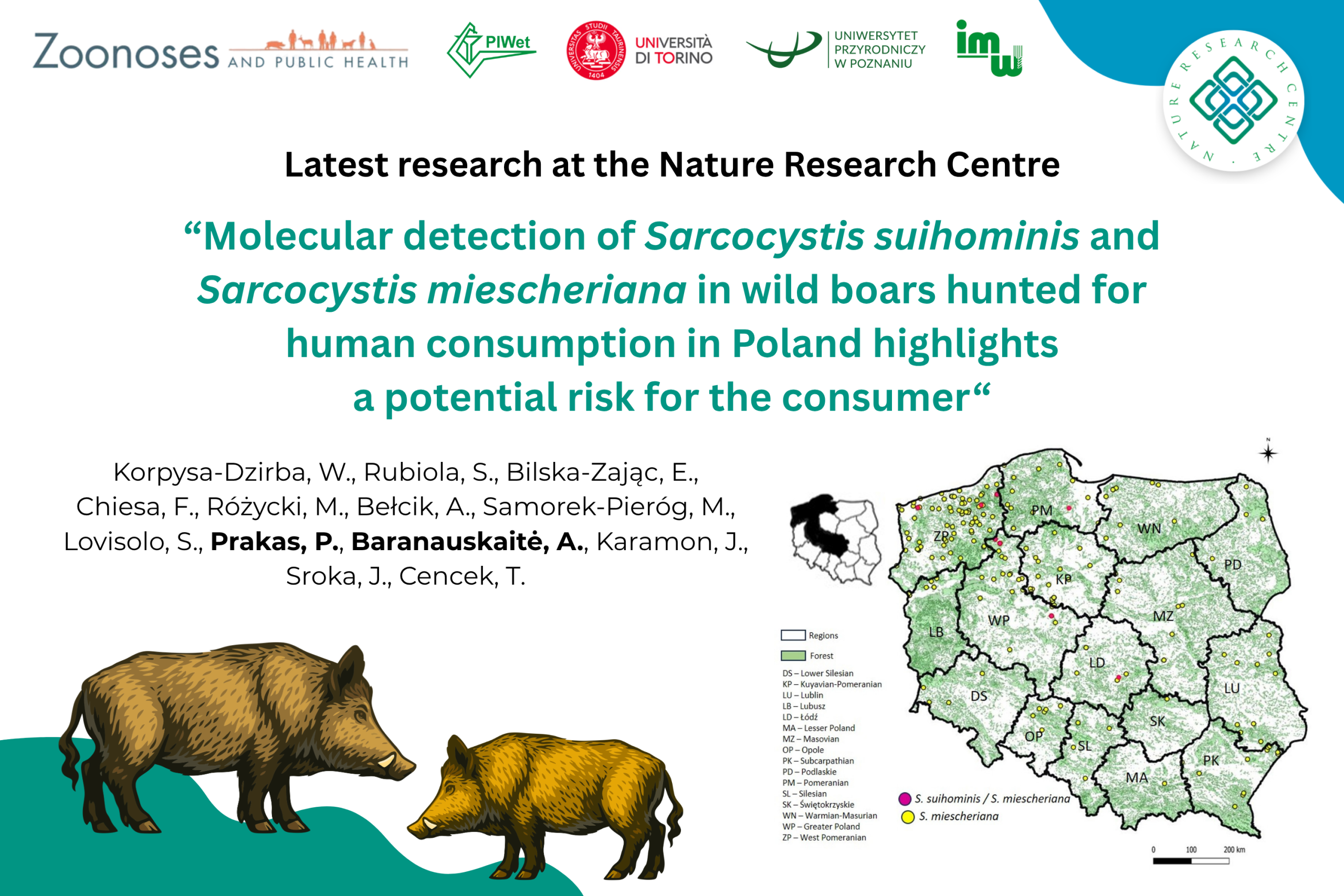
We are pleased to share a new scientific publication co-authored by Dr Agnė Baranauskaitė-Lengvinienė, Research Scientist at the Genetics Laboratory, and Dr Petras Prakas, Principal Research Scientist at the Molecular Ecology Laboratory, together with researchers from Poland and Italy.
The article, “Molecular detection of Sarcocystis suihominis and Sarcocystis miescheriana in wild boars hunted for human consumption in Poland highlights a potential risk for the consumer,” has been published in the international peer-reviewed journal Zoonoses and Public Health (Wiley).
Zoonoses and Public Health is an international scientific journal dedicated to research on zoonotic diseases, their transmission, prevention and control, and their implications for public health. The journal is indexed in Web of Science and MEDLINE/PubMed and currently has a Journal Impact Factor of 2.6 and a CiteScore of 5.3.
What did the study reveal?
The researchers examined 241 diaphragm samples from wild boars hunted during two hunting seasons in Poland. Molecular methods were used to investigate the occurrence of two Sarcocystis species: Sarcocystis miescheriana and the zoonotic Sarcocystis suihominis.
The results showed that:
🔹 90% of the examined wild boars were positive for S. miescheriana DNA;
🔹 3.3% of the animals were co-infected with S. miescheriana and the zoonotic S. suihominis;
🔹 37 sarcocysts were isolated from tissues of wild boars, with two subsequently identified by molecular analysis as S. suihominis;
🔹 the study also revealed a putative new Sarcocystis species, with genetic sequences substantially different from those of currently known species.
Why does this matter?
Sarcocystis suihominis is a zoonotic parasite that can infect humans through consumption of raw or undercooked infected meat. Monitoring infections in wild boars intended for human consumption is therefore important not only for animal health, but also for food safety and public health.
The study is particularly significant because it is the first investigation identifying Sarcocystis species circulating in wild boars intended for human consumption in Poland. The findings demonstrate a very high prevalence of S. miescheriana and confirm the presence of the zoonotic S. suihominis, meaning that a potential risk to consumers cannot be excluded.
The research also highlights the value of modern molecular diagnostic methods in wildlife disease surveillance. Molecular tools can not only detect and identify parasites, but also reveal their genetic diversity and help identify potentially undescribed species.
We are proud of the contribution of Lithuanian researchers to this international study, bringing together expertise in genetics, molecular ecology, parasitology, veterinary science and public health.
The key message is clear: the potential risk of infection cannot be excluded when wild boar meat is consumed undercooked, highlighting the importance of appropriate heat treatment as a key preventive measure.
Find out more: http://doi.org/10.1111/zph.70092