A new study opens up possibilities for more accurate monitoring of parasite transmission in the environment and assessing potential risks to animal and human health.
In collaboration with researchers from the Faculty of Medicine and Life Sciences at the University of Latvia, a preliminary study was conducted to explore a new method for assessing the viability of Sarcocystis parasites in environmental water samples.
These parasites can infect livestock, while some species are also relevant to human health. Microscopic parasite structures known as sporocysts are released into the environment through the faeces of infected animals. They can contaminate water sources, animal feed, and pastures, creating opportunities for further parasite transmission.
Until now, molecular methods have been widely used to detect these parasites and identify their species. However, such methods cannot determine whether the detected parasites are actually viable and capable of causing infection.
The study explored the use of flow cytometry, an advanced laboratory technique that uses fluorescent dyes to analyse individual particles and distinguish between parasite populations based on their fluorescence characteristics. Water samples collected from Lithuanian livestock farms were also examined using species-specific PCR and genetic sequencing.
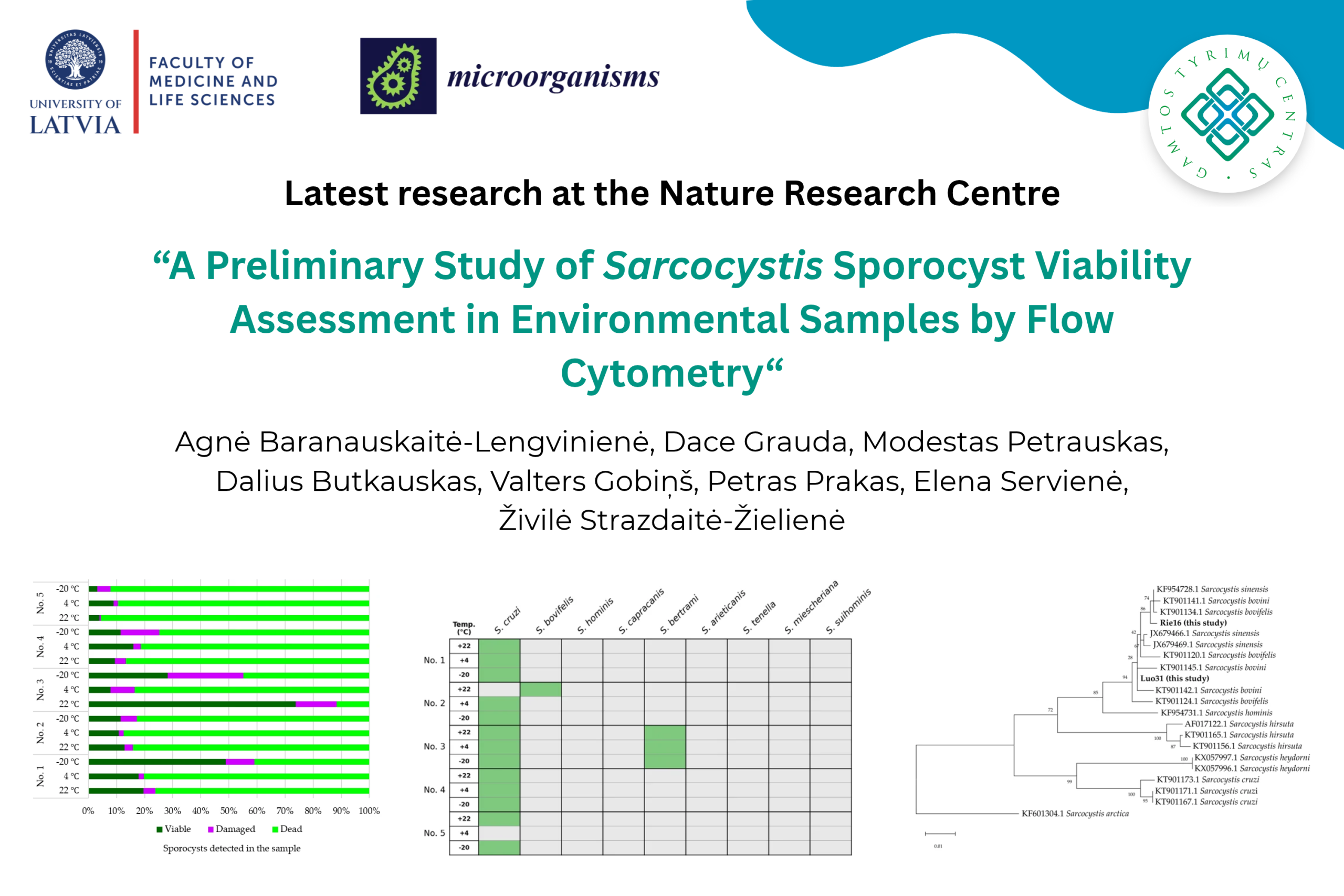
The flow cytometry results showed that sporocysts could be classified into three groups based on their fluorescence profiles. Of all the analysed sporocysts, 64.8% were assigned to the dead category, 22.8% to the viable category, and 12.4% to the damaged category. Differences in the distribution of these populations were also observed between farms.
Molecular analyses revealed that cattle-infecting Sarcocystis cruzi was detected in samples from all investigated farms. Other parasite species were also identified, including the zoonotic species Sarcocystis hominis, which is relevant to human health.
Why is this research important?
The study demonstrates that flow cytometry could become a promising tool for analysing the fluorescence characteristics of parasites found in environmental samples and providing a preliminary assessment of their condition. Its main advantages include speed, quantitative results, and the ability to analyse large numbers of samples.
Combining flow cytometry with molecular techniques could provide more comprehensive information about environmental parasites in the future, helping researchers identify their species and better assess their biological condition. This approach could contribute to more effective environmental monitoring, improved assessment of infection risks, and the protection of animal and human health.
Nevertheless, the researchers emphasise that these findings are preliminary. The fluorescence-based classification of sporocysts has not yet been independently validated using biological assays. Further experiments are therefore needed to determine whether the identified groups reliably reflect parasite viability and their ability to cause infection.
Despite these limitations, the study represents an important step towards developing new and more advanced approaches to monitoring parasite transmission in the environment and understanding the associated risks. It also highlights the importance of international scientific collaboration in developing and applying innovative research methods.
Read more: https://doi.org/10.3390/microorganisms14112571