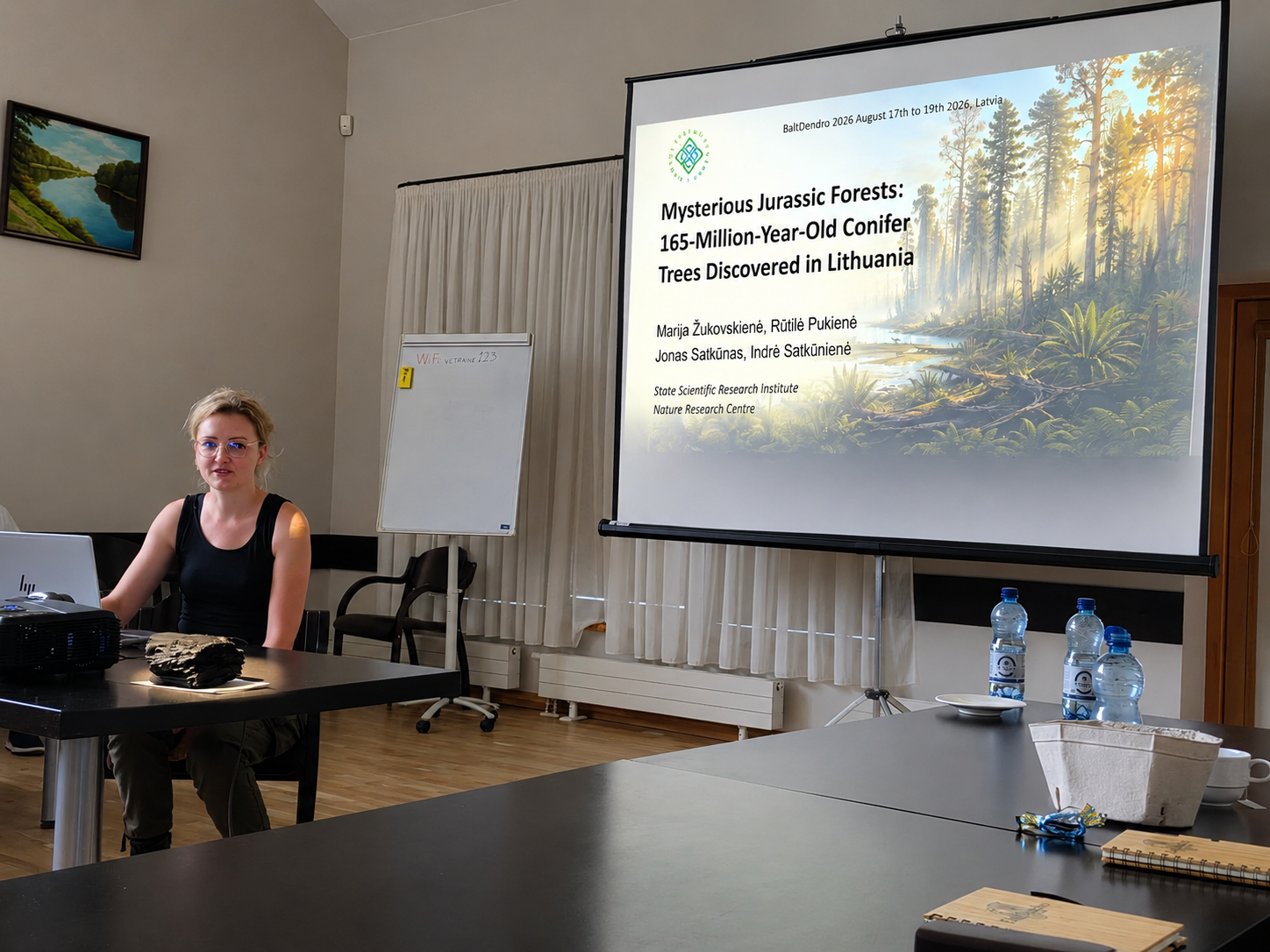
Dr. Marija Žukovskienė, NRC Senior Researcher, presented a paper “Mysterious Jurassic Forests: 165-Million-Year-Old Conifer Trees Discovered in Lithuania” at the international BaltDendro 2026 conference in Latvia on 17–19 August 2026.
What did Lithuania’s forests look like 165 million years ago? What kind of trees grew there?
Scientists are seeking answers to these questions by studying the fossilized Jurassic-period wood discovered at the Karpėnai limestone quarry, north-western Lithuania. Although Lithuania’s Jurassic period deposits are best known for their marine fossils, these wood finds open a completely different window into the past—allowing us to glimpse the terrestrial vegetation and ancient coniferous forests that existed at that time.
Microscopic studies of wood anatomy allow us to distinguish at least three different groups of coniferous wood. The traces of annual rings, tracheid pairs, wood rays, and other anatomical structures preserved in the wood help to gradually reconstruct the history of the trees that grew in what is now Lithuania approximately 165 million years ago.
This presentation was prepared in collaboration with co-authors Dr. Rūtile Pukienė, Dr. Jonas Satkūnas, and Indrė Satkūnienė.
However, this time, the Jurassic period forest was not limited to photographs and microscopic images at the conference.
Dr. Marija Žukovskienė also brought one of the fossilized wood fragments to Latvia. Thus, conference participants had a unique opportunity not only to hear about this find, but also to hold in their hands a piece of wood from a tree that grew in the territory of the present Lithuania approximately 165 million years ago.
This is a moment when geological time—which is so difficult to grasp—becomes almost tangible: the object you hold in your hand comes from a world that existed long before humans appeared.
The research is just getting started. Scientists continue to analyze the poorly preserved and, in some places, pyritized wood, searching for better-preserved samples and comparing the finds from Lithuania with fossilized wood from other parts of Europe dating to the Jurassic period.
These small, dark pieces of wood are expected to eventually allow us to describe in eater detail what Lithuania’s forests were like 165 million years ago.